 Cancun Yacht Rentals Mexico
Sargassum in Cancun: What It Is, When It Comes and Where the Water Stays Clear
The sargassum Cancun beaches get is brown seaweed that drifts onto the east-facing Hotel Zone beaches in a season that runs from late spring through summer. This page explains what sargassum is, how the state semaphore works, what the Navy actually collected, and which beaches stay clear. The quick way around a red-flag beach is the water on the other side of the lagoon: a Cancun yacht charter to the bay and Isla Mujeres is a 30 to 40 minute run from the lagoon marinas. The bookable charters are compared on all Cancun yacht rentals.
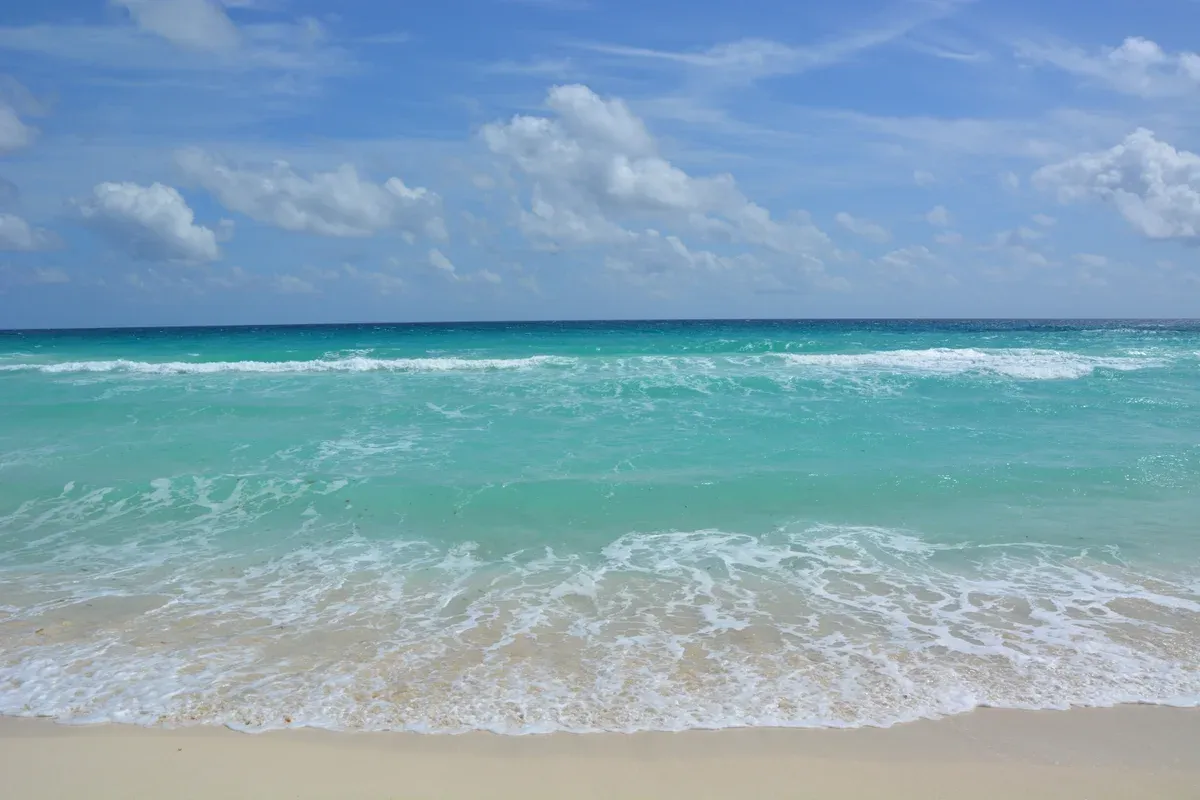
The Hotel Zone shore that most Cancun yacht rentals cruise past. Photo: G.Mannaerts, CC BY-SA 4.0, via Wikimedia Commons
Quick answer Sargassum in Cancun at a glance
Sargassum in Cancun is worst from late spring through summer, with the 2025 peak collection month at 18,419 tons in July across Quintana Roo. The state monitors 140 beaches daily with a five-colour semaphore, and on the state's May count most of them sat in red or abundant status. On the July readouts, Playa Tortugas, Playa Langosta, Playa Caracol and Isla Mujeres were greener than the east-facing Hotel Zone strip. A private boat day is the simplest way to put clean water between you and the seaweed.
Key takeaways
- Check the daily SEMA semaphore before you pick a beach, and skip anything on orange or red. See where the boats leave to start from a nearby dock instead.
- The clearest swimming near Cancun is on Isla Mujeres, about 13 km offshore, which the semaphore showed at minimal presence on a recent statewide count. The Playa Norte Isla Mujeres guide covers the best-known beach there.
- A 46ft Private Yacht Rental from $250 per group for 1 to 6 hours takes up to 15 people across the bay.
- Timing matters as much as location. The best time to visit Cancun guide breaks down the months, and the comparison table shows every boat side by side.
What Sargassum Is and When It Comes
Sargassum is not a local pollution problem. It is a drifting seaweed from the open Atlantic, and its arrival in Cancun follows a pattern that scientists have tracked since 2011.
A Drifting Seaweed from the Open Atlantic
Sargassum is a genus of brown seaweed with over 300 species. Two of them, Sargassum natans and Sargassum fluitans, live their whole lives afloat, drifting in mats pushed by current and wind. Since 2011, the Great Atlantic Sargassum Belt has produced record inundations across the Caribbean, and strong events have returned every 2 to 3 years. One 2018 bloom measured over 1,600 square km, more than three times the average size.
When it washes ashore and rots, decomposing sargassum releases hydrogen sulfide and ammonia, which have been linked to coughing, shortness of breath, headaches, dizziness and nausea. That is a health reason, not just a cosmetic one, to pick your beach with the semaphore in hand. At sea the mats matter too. Floating sargassum blocks light to corals and seagrass, fouls propellers and can entangle turtles and marine mammals.
The state government now says sargassum is no longer strictly seasonal and needs permanent monitoring. Cancun Trip Insider notes that a snorkel guide blames the east-facing coast from May to August, while winter remains among the lowest-sargassum times of the year.
Month by Month on the Cancun Beaches
The table below summarizes how the season typically plays out on the Cancun coast, using the figures the monitoring agencies and news reports give. Collection tonnage across the state peaked from June through August, with July the single heaviest month at 18,419 tons. By October the arrivals are in a declining phase, and SEMAR rated the whole state at very low on 8 October with only 3,920 tons at sea.
Exact beach conditions change within a single day because of currents and beach cleaning, so treat the table as a planning shape, not a forecast.
| Months | Level | What the beaches look like |
|---|---|---|
| Winter | Low | Winter is among the lowest-sargassum times of the year. |
| May to August | Rising to peak | A snorkel guide reports the east-facing coast affected from May to August. State collection peaked at 18,419 tons in July. |
| June and July | Peak arrivals | Por Esto calls June and July the peak months. In May, most of the 140 monitored beaches sat in red or abundant status. |
| September and October | Declining | 2025 collections fell to 12,086 tons in September and 5,660 tons in October. SEMAR rated the state very low on 8 October with 3,920 tons at sea. |
| November | Low | The 2025 season officially ended on 31 October. |
Which Cancun Beaches Get Hit
The Hotel Zone tourist strip runs about 22.5 km and its east-facing beaches take the brunt. On the state count of 26 May, Punta Cancun and Gaviota Azul had been red for more than a week. One day in late April had 17 of the 100 northern-zone beaches in red.
The sheltered side does better. On 29 July, SEMA data showed Playa Tortugas, Playa Langosta and Playa Caracol at green while Playa Delfines sat at yellow on the same day. The sources do not say why the bay side stays greener, so this is a pattern and not an explanation. Farther north, Punta Sam, Isla Blanca, Isla Contoy and Chiquila all appeared on a sargassum-free list on 24 July, and Isla Mujeres showed minimal presence overall that day.
How to Check the Beaches
Two systems run in parallel. The state environment ministry publishes a daily beach semaphore, and the Mexican Navy reports what is drifting at sea and what has been collected.
The Semaphore Colours and Who Publishes Them
The state environment ministry, SEMA, runs a daily five-colour semaphore across 140 beaches in Quintana Roo. The scale runs red for excessive, orange for abundant, yellow for moderate, green for low and blue for none. The same article advises not swimming at orange or red beaches. A Hotel Zone version of the semaphore often appears with four colours instead, green for minimal, yellow for moderate with partial impact, orange for considerable and red for abundant, and levels can change within a single day because of hotel beach cleaning and currents.
SEMA's count of 8 October mapped 140 beaches and reported 21 at an excessive level, with a falling trend after the June to July peak. The Navy (SEMAR) uses its own green, very low rating for the state as a whole, which it held on 8 October with 3,920 tons at sea, six clusters in view and 31 tons expected within 24 hours.
The SEMAR Collection Figures, and Where They Disagree
The Navy's collection numbers are large and the sources do not fully agree. For 2025, Semar's final count was 91,505 tons across Quintana Roo, 147 percent more than the roughly 37,000 tons of 2024, with the 11 municipalities doing most of the collecting. A state government figure earlier that season had put the total at about 84 thousand tons, below a 120 thousand forecast, on a different cut-off date.
For 2026 the conflicts widen. Riviera Maya News reports 90,548 tonnes collected in the state by 28 August, with May and June the peak period. N+ reports 96,000 tons collected and 119,000 expected, and puts Cancun extraction at 60 to 80 tons a day in spring 2026. A Por Esto headline of early October calls the 2026 season a record with 138 thousand tons collected.
The cleanup effort is real but limited. In the 2025 strategy, by mid-July the Navy had containment barriers, one ocean-going sargassum vessel taking up to 90 tons a day, 11 coastal boats, 22 smaller units and 400 personnel. Esteban Amaro of the state sargassum monitoring network says the volume makes a complete cleanup practically impossible. Benito Juarez, which is Cancun, plus Playa del Carmen and Isla Mujeres, saw Semar's heaviest work. Funding is in place too, with the Marina holding 19.5 million pesos for anti-sargassum strategies and Fonatur planning 500 million pesos for 2027 management.
Barriers, Booms and Hotel Beaches
Some Cancun hotels close their private beaches to remove sargassum and others use temporary containment booms offshore. Playa Norte on Isla Mujeres regained its Blue Flag in April after about 1,500 tons of sargassum were collected there since January, which shows even the sheltered island needs clearing in heavy years. Costa Mujeres was downgraded to an orange flag in the same April and returned to green within days.
Sources: Riviera Maya News, Por Esto, Grupo Animal
The Cancun Sargassum Situation
A traveller explains how sargassum affects Cancun beaches. Third-party video by HiBreak. This site did not shoot it and has no relationship with the creator.
Where the Water Stays Clear
The simplest answer to seaweed in Cancun is to swim where the seaweed is not: the bay side of the Hotel Zone and Isla Mujeres.
The Bay Side, Playa Tortugas and the Island
The lagoon-side and bay-side beaches of the Hotel Zone include Playa Tortugas, Playa Langosta and Playa Caracol, which were all green on the 29 July SEMA readout while Playa Delfines was yellow. Punta Sam and Isla Blanca, north of the strip, made a sargassum-free list on 24 July.
Isla Mujeres is the strongest bet. It lies about 13 km off the Yucatan coast. The island showed minimal sargassum overall on the July statewide count, and Playa Norte and Playa Centro hold Blue Flag and Platinum Beach certification. Playa Norte itself is known for shallow turquoise water you can wade a long way out in, and about 1,500 tons were still cleared there between January and April of a heavy year. For the beach in depth, see the Playa Norte Isla Mujeres guide.
Boat Days That Put the Seaweed Behind You
A private yacht from the Cancun lagoon marinas reaches Isla Mujeres in 30 to 40 minutes, with operators quoting anywhere from about 20 to 45 minutes depending on the boat. That puts you at the island well within a morning. Prices are per boat for the whole group.
The cheapest private start is the 46ft Private Yacht Rental at $250 per group for 1 to 6 hours, for up to 15 guests with snorkel gear, bottled water and ice included. A step up, the 55ft Luxury Yacht Charter is listed from $357.44 per group for 1 to 8 hours, taking up to 20 people with a paddle board and floating mattress aboard. For a full island day, the Azimut 47 Yacht to Isla Mujeres spends 6 hours on a route past Punta Sur and Playa Norte at $2,310 per group for up to 18 guests, with a captain and two sailors crewing it. All three are private charters where dock or park fees are paid on top. Every listing here is compared in the Cancun yacht rentals lineup.
Sources: Por Esto, Riviera Maya News
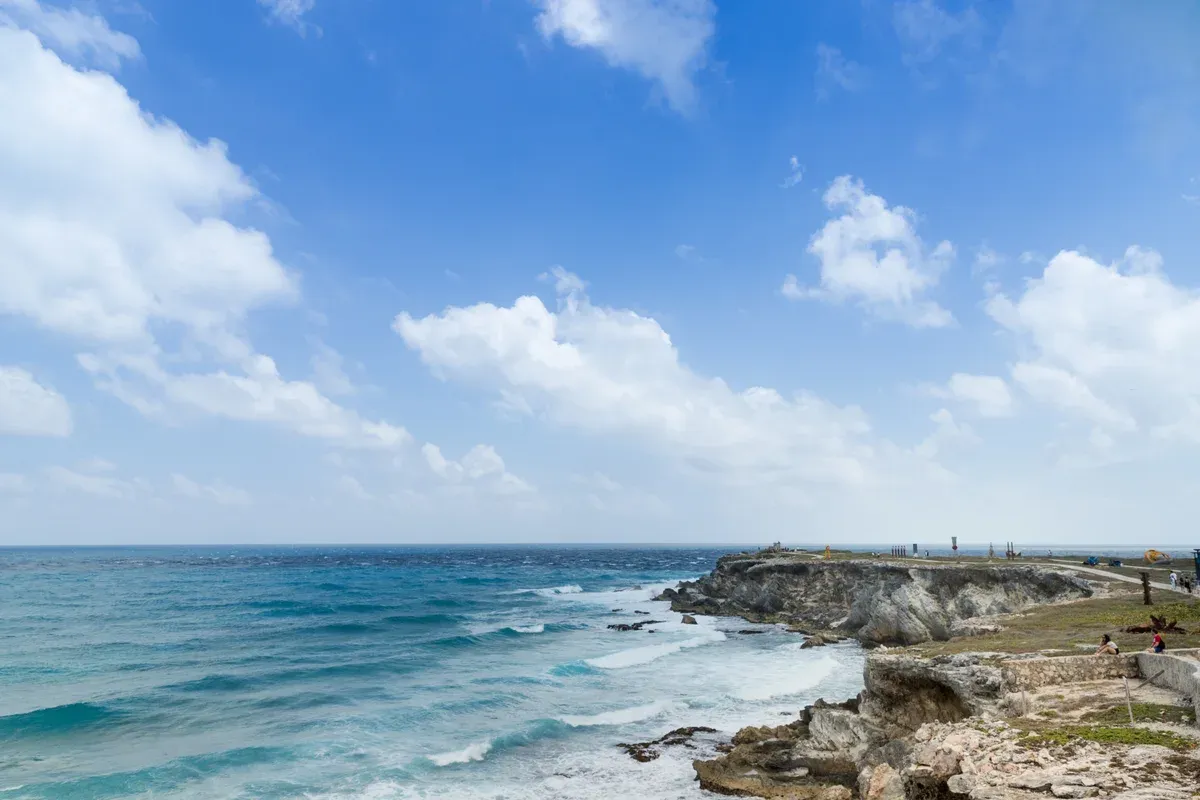
The cliffs and open sea at Punta Sur, the southern tip of Isla Mujeres. Photo: dronepicr, CC BY 2.0, via Wikimedia Commons
Sargassum Tips for Cancun
Do
- Do check the SEMA semaphore the morning you go to the beach, because levels can change within a single day with currents and beach cleaning, and one article advises against swimming on orange or red beaches.
- Do choose bay-side beaches such as Playa Tortugas, Playa Langosta and Playa Caracol, which sat at green on the same July day that Playa Delfines was yellow.
- Do plan a boat day to Isla Mujeres, which showed minimal sargassum overall in the July statewide count and holds Blue Flag certification for Playa Norte and Playa Centro.
- Do favor winter and the shoulder months, since winter is among the lowest-sargassum times of the year and collections fell from a July peak of 18,419 tons to 5,660 tons in October.
- Do book a morning departure, because a snorkel guide advises it since wind builds after 11:00, and a calm crossing makes the 30 to 40 minute run to the island easier.
Don't
- Don't assume the whole coast is the same, because the east-facing Hotel Zone beaches took the hits in May with Punta Cancun and Gaviota Azul in red for more than a week, while the bay side read green on the July readouts.
- Don't swim near thick rotting weed, because decomposing sargassum releases hydrogen sulfide and ammonia, linked to coughing, shortness of breath, headaches, dizziness and nausea.
- Don't trust a single collection headline as the season total, because the 2026 figures range from 90,548 tonnes by late August to a claimed record 138 thousand tons, depending on the source and cut-off date.
- Don't expect crews to clear everything, because Esteban Amaro of the state monitoring network says the volume makes a complete cleanup practically impossible.
Sargassum in Cancun: Questions and Answers
Does Cancun have sargassum now?
Check the daily semaphore rather than guessing. On 8 October the Navy held Quintana Roo at a green, very low rating with 3,920 tons at sea, while SEMA still mapped 21 of its 140 beaches at excessive on the same day. Conditions vary by beach within hours, so read the current state map, and consider a 46ft Private Yacht Rental that takes you across the bay where the water runs clearer.
What months is sargassum bad in Cancun?
The worst stretch runs from late spring through summer. In 2025, state collection peaked in July at 18,419 tons, after 15,803 tons in June and before 16,720 tons in August, and fell to 5,660 tons by October. The best time to visit Cancun guide matches the seaweed pattern against weather and crowds month by month.
Is Cancun full of sargassum?
At the peak it is widespread but not universal. On the May count, most of the 140 monitored beaches sat in red or abundant status, with Cancun extraction running at 60 to 80 tons a day in spring. On the July readouts the bay side and Isla Mujeres did better, and a boat day such as the 55ft Luxury Yacht Charter gets you to the island, a run of 30 to 40 minutes from the lagoon marinas.
Where in Cancun is there no sargassum?
Green readouts came from the bay side and the island. Playa Tortugas, Playa Langosta and Playa Caracol were all green on 29 July, Punta Sam and Isla Blanca made a sargassum-free list on 24 July, and Isla Mujeres showed minimal presence overall. Playa Norte is the island's flagship beach and the Playa Norte Isla Mujeres guide covers it in depth.
Is the sargassum a health risk in Cancun?
It can be when it rots in quantity on the sand. Decomposing sargassum releases hydrogen sulfide and ammonia, which have been linked to coughing, shortness of breath, headaches, dizziness and nausea. One article advises not swimming at orange or red beaches. Staying out on the water is one way around it, and the Private Catamaran Charter sails 4 or 7 hours to Isla Mujeres or around the bay from $899 per group with an open bar included.
Can I still swim with whale sharks if sargassum is bad?
Yes, because the two do not overlap. The whale shark aggregation zone sits north of Isla Mujeres in deep open ocean, so the coastal seaweed does not reach it. The official season runs 15 May to 17 September, peaking in July and August. None of the boats compared in the Cancun yacht rentals compared lineup is a whale shark tour.